
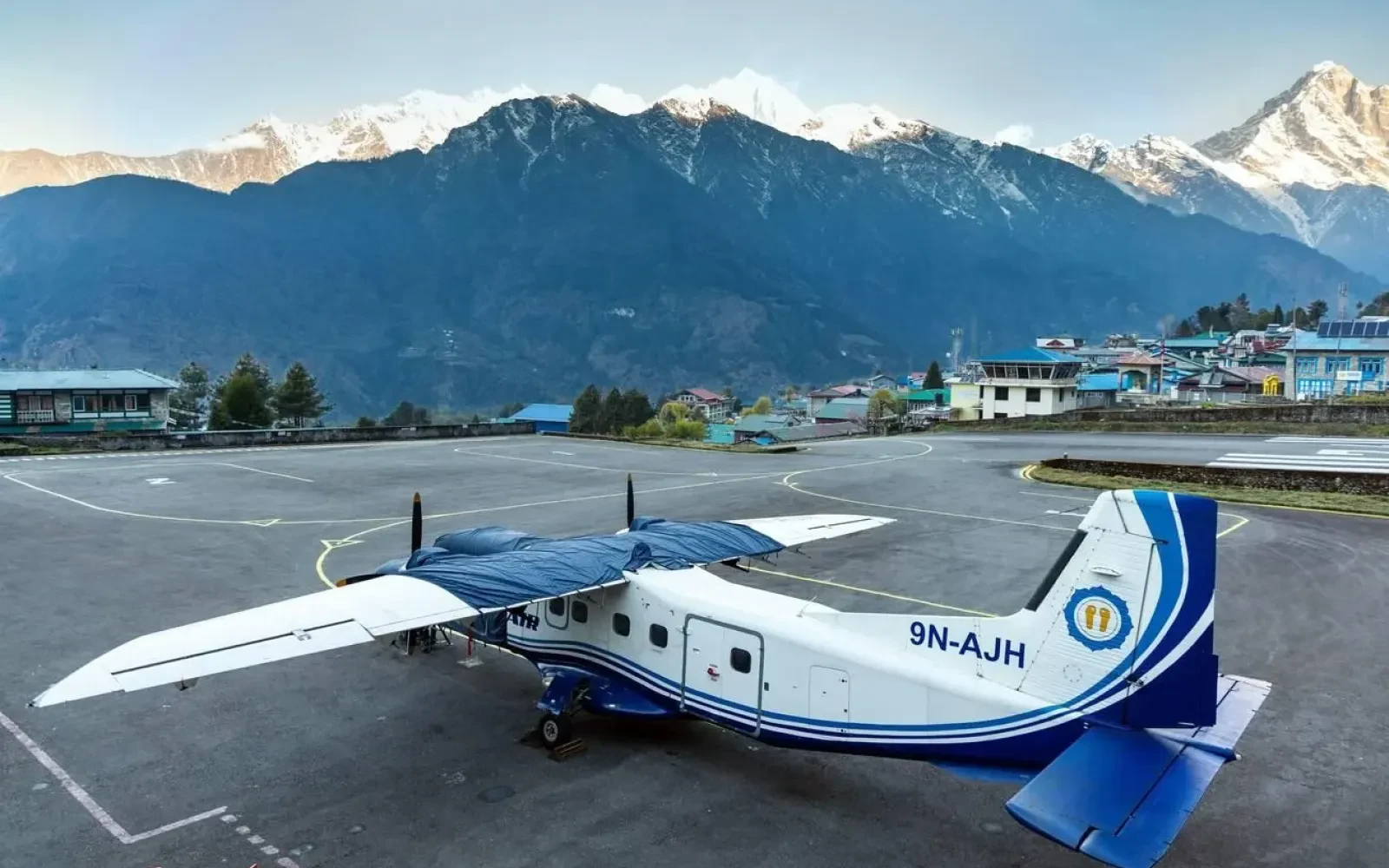
Yes, a helicopter flight between Syangboche Airport and Tenzing-Hillary Airport (Lukla) is not only possible but also commonly used in the Everest region. Due to the extreme terrain, unpredictable weather, and limited fixed-wing connectivity, helicopters operated by companies like Air Dynasty Heli are often the most reliable and flexible transport option.
This short but high-altitude flight is typically arranged for trekkers, climbers, and emergency transfers. It bypasses difficult trekking routes and provides a safe, controlled aerial connection between two of the most important aviation points in the Khumbu region.
Key highlights:
The helicopter journey from Syangboche to Lukla is one of the shortest yet most visually dramatic flights in the Himalayas. Despite lasting only around 10–15 minutes, it captures some of the most iconic scenery of the Everest region, making it a memorable aviation experience.
Operated by experienced Himalayan carriers such as Air Dynasty Heli, this route is popular among travelers who want to experience high-altitude flight without committing to long trekking routes. The combination of altitude, terrain, and weather makes every flight unique.
Key highlights:
The route between Syangboche Airport and Tenzing-Hillary Airport (Lukla) is a short but technically demanding flight corridor in the Khumbu region. The helicopter ascends and navigates through narrow valleys surrounded by towering Himalayan peaks before descending toward Lukla’s famously steep runway.
Pilots from operators like Air Dynasty Heli rely heavily on visual flight rules (VFR), meaning clear weather conditions are essential. The terrain leaves little margin for error, making this one of the most skill-sensitive short-distance helicopter routes in the world.
Key highlights:
Syangboche Airport is one of the highest airstrips in the world and holds a unique place in Himalayan aviation. Located near Namche Bazaar, it was originally developed for small aircraft operations and now primarily serves helicopter landings and special missions.
Due to its altitude and challenging environment, only skilled pilots from experienced operators such as Air Dynasty Heli can safely operate here. The airport is surrounded by dramatic Himalayan landscapes, making it both operationally challenging and visually spectacular.
Key highlights:
A helicopter flight between Syangboche Airport and Tenzing-Hillary Airport (Lukla) is technically possible and routinely conducted in the Everest region. Operators such as Air Dynasty Heli regularly use high-performance helicopters designed for extreme altitude operations to connect remote Himalayan locations.
Although the distance is short, the route requires careful planning due to terrain constraints and altitude limitations. Flights are usually scheduled during optimal weather windows, and they often serve trekking logistics, emergency evacuation, and supply transfer missions.
Key points:
One of the biggest challenges on this route is extreme altitude. Both Syangboche and Lukla sit at elevations where oxygen levels are significantly lower, affecting both aircraft performance and engine efficiency. Helicopters must operate near their performance limits to maintain lift and stability.
For operators like Air Dynasty Heli, payload management becomes critical. Pilots often adjust passenger weight, fuel load, and timing to ensure safe takeoff and landing under thin-air conditions.
Key points:
The Everest region is known for rapidly changing weather conditions. Even when flights begin under clear skies, wind patterns and cloud formations can shift within minutes, making visibility uncertain. This unpredictability is one of the main operational challenges for helicopter services.
Companies like Air Dynasty Heli rely heavily on real-time weather monitoring and early-morning flight scheduling to maximize safety. Flights are often delayed or canceled if conditions do not meet strict visibility and wind thresholds.
Key points:
Although remote, the Syangboche–Lukla corridor is one of the busiest helicopter and trekking aviation routes in Nepal. Traffic includes helicopters, fixed-wing STOL aircraft, and emergency evacuation flights, all operating within a narrow valley system.
To maintain safety, operators such as Air Dynasty Heli must follow strict Civil Aviation Authority guidelines, coordinated flight timings, and controlled airspace procedures around Tenzing-Hillary Airport (Lukla).
Key points:
Helicopter operations between Syangboche Airport and Tenzing-Hillary Airport (Lukla) are heavily influenced by the extreme altitude of the Khumbu region. At these elevations, the air is significantly thinner, which reduces rotor efficiency, engine power output, and overall lift capability. This means helicopters cannot carry full payloads like they would at lower altitudes.
Operators such as Air Dynasty Heli must carefully calculate weight distribution, fuel load, and passenger numbers before every flight. Even small changes in temperature or wind conditions can affect performance margins, making precision essential for safe operations.
Key points:
Flying in the Everest region requires highly skilled pilots with extensive mountain flying experience. The route between Syangboche and Lukla is short but extremely technical, with narrow valleys, sudden wind shifts, and limited emergency landing options. Only specially trained pilots are authorized to operate in such environments.
Companies like Air Dynasty Heli ensure that their crews are trained in high-altitude navigation, visual flight rules (VFR), and rapid decision-making. Operational constraints such as limited communication coverage and unpredictable terrain turbulence add further complexity.
Key points:
Safety is the top priority on helicopter routes connecting Syangboche Airport and Tenzing-Hillary Airport (Lukla). The combination of altitude, terrain, and weather creates multiple risk factors, including sudden downdrafts, low visibility, and mechanical stress on aircraft systems.
Operators like Air Dynasty Heli follow strict safety protocols, including early morning departures, continuous weather monitoring, and immediate flight cancellation if conditions become unsafe. Passenger safety briefings and emergency preparedness are standard procedures before every flight.
Key points:
Helicopter transfers in the Everest region are premium services due to operational complexity, fuel requirements, and limited aircraft availability. Flights between Syangboche and Lukla are typically arranged for trekking groups, rescue operations, or time-sensitive travel needs.
With companies such as Air Dynasty Heli, logistics involve coordinated scheduling, weight balancing, and weather-dependent timing. Costs vary depending on group size, flight purpose, and seasonal demand, making planning essential.
Key points:
A helicopter flight between Syangboche Airport and Tenzing-Hillary Airport (Lukla) is not a daily scheduled service, but it is occasionally used in specific real-world situations. Operators such as Air Dynasty Heli may deploy this route for logistical repositioning, emergency evacuations, or special charter requests in the Everest region.
In most cases, this flight is arranged when ground travel is impractical or when time-sensitive movement is required between key Himalayan hubs. Because both locations are strategically important for trekking and rescue operations, helicopters provide a flexible aerial bridge when conditions allow.
Key points:
Since direct helicopter movement between Syangboche and Lukla is highly weather-dependent, travelers often rely on alternative transport options. The most common alternative is a direct helicopter transfer from Kathmandu to Lukla or trekking between regional villages such as Namche Bazaar and Lukla.
Operators like Air Dynasty Heli typically offer flexible routing options depending on weather conditions, including bypassing Syangboche entirely. Fixed-wing STOL flights to Lukla are also widely used when helicopter operations are restricted or cost-prohibitive.
Key points:
The idea of a regular Syangboche-to-Lukla helicopter flight is somewhat misleading. While technically possible, it is not a standard scheduled service and is instead an occasional operational decision based on necessity, weather, and logistics. In that sense, it sits between reality and rarity rather than being a common route.
Companies like Air Dynasty Heli confirm through operational practice that such flights do occur, but only under suitable conditions. For most travelers, the route is better understood as a situational helicopter corridor rather than a fixed commercial connection.
Key points:
The Tengboche to Kathmandu helicopter route offers one of the most efficient and visually stunning ways to transition from the high Himalayas to Nepal’s capital. Operated by Air Dynasty Heli, this journey replaces several days of trekking with a single scenic flight, allowing travelers to experience the Everest region from an entirely different
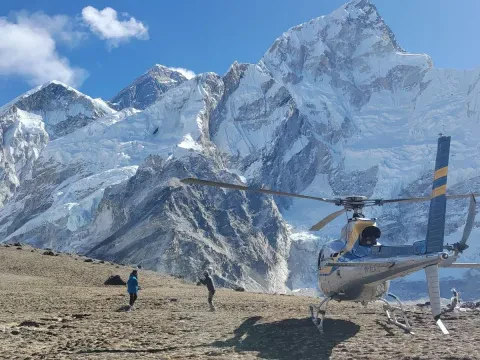
The Luxury Aerial Transfer from Kala Patthar to Kathmandu, operated by Air Dynasty Heli, is a premium Himalayan flight experience that replaces the long descent on foot with a swift, scenic helicopter journey. Starting from Kala Patthar (5,644.5m), this service offers travelers a comfortable, high-altitude exit from the Everest region
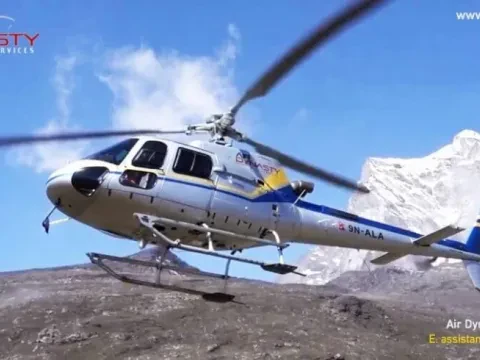
An aerial view of Mount Everest offers one of the most extraordinary visual experiences on Earth. From above, the world’s highest peak rises dramatically through a vast ocean of clouds, revealing its immense scale, glacial ridges, and surrounding Himalayan giants. This perspective transforms Everest from a distant summit into a living, breathing