
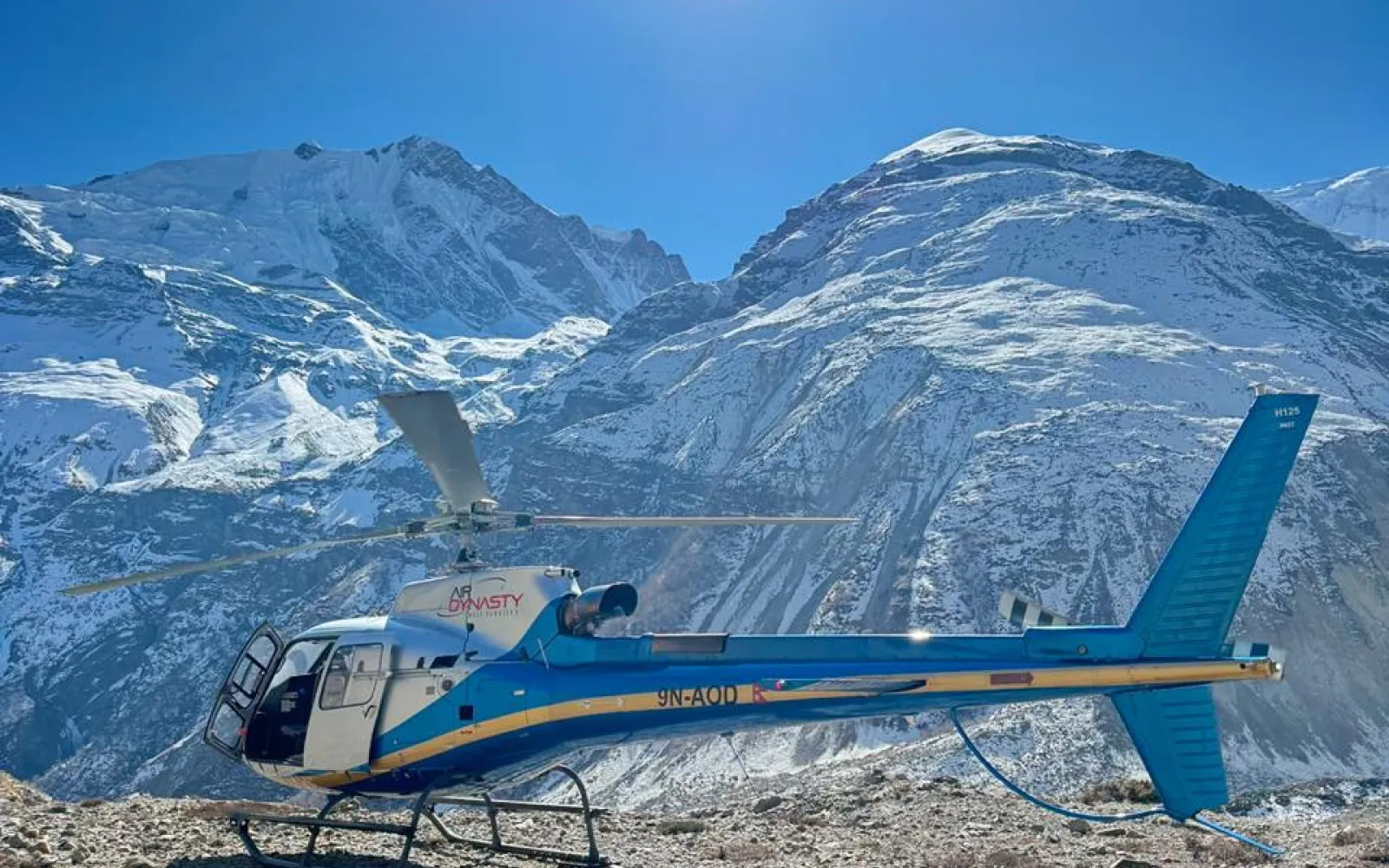
An Everest Base Camp helicopter tour offers a convenient way to experience the Everest region without committing to a multiday trek. From Kathmandu, the flight takes you toward the Khumbu, with views of the Himalayan landscape, Everest Base Camp, and Kala Patthar along the way.
When booking an Everest helicopter tour, travelers often have two options to consider:
At first, these two options may sound like completely different tours. In reality, the overall route and main Everest experience are very similar. The important difference is what happens at Kala Patthar.
In the first option, both Everest Base Camp and Kala Patthar are viewed from the air. In the second, Everest Base Camp is still overflown, but the helicopter can land at Kala Patthar when weather and operating conditions permit.
One point is especially important: landing at Everest Base Camp is not permitted in either option. Everest Base Camp is overflown in both tours.
The simplest way to understand the difference is to look at the experience at each location.
With this option, the helicopter flies over the Everest Base Camp area and continues over Kala Patthar. Passengers remain on board while viewing both locations from the air.
It is an aerial sightseeing experience focused on seeing the major highlights of the Everest region without a Kala Patthar landing.
This option follows the same general Everest route and also includes an aerial view of Everest Base Camp.
The difference comes at Kala Patthar. Instead of only flying over the viewpoint, the helicopter may land there for a short period, allowing passengers to step outside and experience the high altitude surroundings from the ground.
The landing remains subject to actual operating conditions and the pilot's decision.
One of the most common points of confusion when comparing Everest helicopter tours is the difference between seeing Everest Base Camp and landing at Everest Base Camp.
For these tour options, the helicopter provides an aerial view of Everest Base Camp.
There is no landing at Everest Base Camp in either itinerary.
The helicopter approaches the Everest Base Camp area to provide passengers with an aerial perspective before continuing toward Kala Patthar.
Therefore, choosing the Kala Patthar landing option does not mean that the helicopter lands at Everest Base Camp. The landing experience is specifically at Kala Patthar.
Regardless of which option you choose, the journey begins in Kathmandu.
Our team assists with the necessary preparation before the helicopter departs toward the Everest region. As the aircraft leaves the Kathmandu Valley, the scenery gradually changes from the lower hills to the dramatic mountain landscape of the Khumbu.
Lukla can serve as an operational or refueling stop depending on the day's flight plan and aircraft requirements.
From Lukla, the helicopter continues toward the higher Everest region.
As the flight progresses, passengers can see the valleys and mountain landscapes associated with the Everest trekking route. The aerial perspective provides a view of the terrain that would otherwise take days to experience on foot.
The Everest Base Camp area is then approached as part of the planned flight.
For many passengers, seeing Everest Base Camp is one of the main highlights of the journey.
From the helicopter, you can look down toward the Base Camp area and see the surrounding landscape from above. The perspective is very different from that of a trekker approaching Base Camp on foot.
You can appreciate the scale of the Khumbu terrain, the surrounding mountains and the route leading toward the high Himalayas.
After the EBC overfly, the flight continues toward Kala Patthar.
This is where your selected tour option determines the next part of the experience.
The EBC and Kala Patthar overfly is the aerial sightseeing option.
After viewing Everest Base Camp, the helicopter continues toward Kala Patthar and flies over the viewpoint. Passengers remain inside the helicopter and can enjoy views of the high-altitude landscape and surrounding Himalayan peaks from above.
There is no scheduled Kala Patthar landing under this option.
This makes the tour particularly suitable for travelers who want to focus on the aerial experience and see the major highlights of the Everest region from the helicopter.
For photographers, the aerial perspective can also provide a broad view of the mountains, valleys and high-altitude terrain.
The flight then continues according to the planned route, including the Everest-region breakfast experience where applicable, before beginning the return journey toward Kathmandu.
The EBC overfly with Kala Patthar landing provides the same core Everest experience but adds a short ground experience for 5-10 minutes at Kala Patthar.
After the helicopter overflies Everest Base Camp, it continues toward Kala Patthar. When weather, visibility, wind, aircraft performance, passenger and baggage weight, landing conditions, and other operational factors allow, the helicopter can land at Kala Patthar.
Passengers can then step outside the helicopter for a short period.
Standing at this altitude gives you a different perspective of the Everest region. Instead of seeing the mountains only through the helicopter windows, you can experience the surrounding landscape directly from the ground.
It also creates an opportunity for photographs with the Himalayan scenery around you.
After the planned landing period, the helicopter departs Kala Patthar and continues with the rest of the tour.
The two options are best understood through the experience they provide at Kala Patthar.
With the overfly option, you experience Kala Patthar from above.
With the landing option, you have the opportunity to experience Kala Patthar from the ground.
This is why the landing option can be attractive to travelers who want more than an aerial view of the Everest region.
At the same time, travelers who are mainly interested in mountain views may prefer the simplicity of an overfly experience.
Although the Kala Patthar experience differs, many parts of the journey remain the same.
Both options can include:
The exact sequence and duration can vary depending on weather, air traffic, aircraft operations, and conditions on the day.
The important distinction is that Kala Patthar is overflown in one option and landed in the other.
For many travelers, a helicopter tour is already an extraordinary way to see Everest. A landing can make the experience feel even more personal.
The opportunity to briefly step outside at Kala Patthar means you are not experiencing the entire journey through the helicopter window.
You can take photographs, look across the Himalayan landscape, and experience the high-altitude environment directly.
This can be particularly appealing for:
The overfly option is ideal for travelers who want to see the Everest region from the air without making a Kala Patthar landing.
The helicopter gives you a wide perspective of the Himalayan terrain, and the flight itself becomes the main experience.
This can be a suitable choice for travelers who:
There is also something special about viewing the landscape continuously from above. The mountains, valleys, glaciers, and trekking routes can be appreciated as one connected Himalayan landscape.
A Kala Patthar landing cannot be guaranteed in advance, as the actual landing depends on the weather conditions encountered on the day of the flight.
High altitude helicopter operations are affected by:
The pilot has the final authority over whether a landing can safely be conducted.
If conditions do not permit a safe landing, the helicopter will overfly Kala Patthar instead.
This is an important part of mountain aviation. A planned itinerary provides the intended experience, but the final operation must always follow the conditions and safety requirements on the day.
Passenger and baggage weight is an important consideration for high altitude helicopter flights.
As altitude increases, aircraft performance is affected, making accurate weight information an essential part of flight planning.
At Air Dynasty, passenger and baggage weight may be considered when planning high-altitude operations. Our team will therefore request accurate passenger weight information before confirming the flight in advance while booking.
This is particularly relevant when a tour includes a high altitude landing such as Kala Patthar.
Providing accurate information helps our operations team and pilots plan the flight appropriately.
Another memorable part of the Everest helicopter experience is the planned breakfast stop in the Everest region.
Depending on the tour operation and conditions, passengers can enjoy breakfast surrounded by the Himalayan landscape before beginning the return journey.
The breakfast stop is not simply a meal during the trip. For many visitors, it becomes another opportunity to pause and take in the mountains after seeing Everest Base Camp and Kala Patthar from the air or experiencing a Kala Patthar landing.
At Air Dynasty, we understand that travelers booking an Everest helicopter tour are not simply purchasing a flight. They are planning a once in a lifetime experience in one of the world's most demanding mountain environments.
Our team coordinates the flight according to the selected tour, passenger requirements, aircraft availability and operating conditions.
Air Dynasty operates a fleet that includes 9N-ALA, 9N-ANA, 9N-AOQ and 9N-AOD, with aircraft assigned according to operational requirements and availability.
For Everest flights, our planning takes into account factors such as passenger and baggage weight, weather, visibility, aircraft performance and landing conditions.
This allows us to plan the intended experience while keeping the actual operation dependent on the conditions encountered during the flight.
If you are comparing the two options, the decision is ultimately about the type of Kala Patthar experience you want.
Choose EBC and Kala Patthar Overfly if you want to experience the Everest region primarily from the air, with aerial views of both Everest Base Camp and Kala Patthar.
Choose EBC Overfly with Kala Patthar Landing if you want the same Everest Base Camp aerial experience with the added opportunity to land at Kala Patthar and briefly experience the landscape from the ground, subject to operating conditions.
There is no need to choose between seeing Everest Base Camp and landing at Kala Patthar. Both options include an EBC overfly. The difference is the Kala Patthar experience.
EBC & Kala Patthar Overfly
See EBC from the air
See Kala Patthar from the air
EBC Overfly + Kala Patthar Landing
See EBC from the air
Land at Kala Patthar for 5-10 minutes only
EBC landing: Not permitted in either option.
The Everest Base Camp helicopter tour is designed for travelers who want to experience the Himalayas without spending weeks on a trekking route.
Whether you choose the aerial perspective of an EBC and Kala Patthar overfly or the added ground experience of an EBC overfly with Kala Patthar landing, the journey takes you into the heart of the Everest region.
From the first mountain views after leaving Kathmandu to the sight of Everest Base Camp from above and the dramatic landscape around Kala Patthar, every part of the journey offers a different perspective of the Himalayas.
If you are looking for a private or shared Everest Base Camp helicopter tour or any other helicopter tour in Nepal, our Air Dynasty team can assist with the appropriate option for your travel date and group.
Your Journey, Our Priority.